

Follow this complete Bordeaux 2 day itinerary to discover what to visit in one of France’s most captivating cities. When visiting Bordeaux, you will uncover one of the country’s highest concentrations of protected historic buildings, second only to Paris. Known as “Little Paris,” the “City of Wine,” or the “Port of the Moon” (due to the wide crescent-shaped bend the Garonne River carves through the city), this southwestern French gem blends monumental classical architecture with world-class culinary and wine culture.

With over 2,000 years of history, France’s sixth-largest city has had its historic center listed as a UNESCO World Heritage Site since 2007. Whether you are planning a weekend getaway or a road trip through southern France, find out what to do in Bordeaux in this complete travel guide, featuring a detailed 2-day walking itinerary, transport tips, and where to stay.
| Topic | Essential Trip Summary |
|---|---|
| Destination & Status | Bordeaux, southwestern France, along the Garonne River; historic center listed as a UNESCO World Heritage Site since 2007. |
| Ideal Duration | 2 days: Day 1 in the historic center and La Cité du Vin; Day 2 in Saint-Émilion / Médoc, Dune du Pilat, or historic fortresses (Blaye and Vayres). |
| Must-See Sights | Triangle d’Or, Grand Théâtre, Place des Quinconces, Place de la Bourse & Miroir d’Eau, Saint-Pierre district, Les Quais, and La Cité du Vin. |
| Transportation | Highly walkable center; TBM network with TRAM (lines A, B, C, and D), buses, and Le Bato river ferry. TRAM Line A connects the airport to the center in ~35–40 min. |
| What to Eat & Drink | Canelés de Bordeaux, Entrecôte à la Bordelaise, Arcachon oysters, Magret de Canard, and red wines (Médoc, Saint-Émilion) or whites (Entre-Deux-Mers / Sauternes). |
| Best Time to Visit | Spring (April–June) and autumn (September–October) for mild weather and balanced prices; summer for the Atlantic coast; December for Christmas markets. |
How Much Does It Cost to Visit Bordeaux for 2 Days? (Estimated Budget)
Planning a 2-day getaway to Bordeaux means balancing your budget across accommodation, local gastronomy, and your Day 2 excursion choices. The figures below are per-person estimates (based on one night in a shared double room) to give you a realistic idea of trip costs, broken down into a budget-friendly style and a mid-range comfort style.
Budget Profile: Ideal if you opt for simple accommodations or practical apart-hotels, casual meals at food markets like Marché des Capucins or Halles de Bacalan, getting around on foot or via TRAM/TER trains, and self-guided visits to major monuments and open squares.
Comfort (Mid-Range) Profile: Designed for a more central stay, bistro dinners featuring entrecôte, oysters, or regional dishes paired with fine Bordeaux wines, plus experiences such as La Cité du Vin, tourist passes, or guided vineyard and coastal tours.
Keep in mind that these totals exclude round-trip travel to Bordeaux (flights, TGV high-speed train, or car), wine and souvenir shopping, and sharper seasonal price spikes during peak summer months or major city events.
| Category | Budget Profile | Comfort (Mid-Range) Profile | Notes |
|---|---|---|---|
| Accommodation (1 night) | ~€45 – €75 | ~€85 – €140 | Per person in a shared double room. |
| Food & Drink (2 days) | ~€50 – €75 | ~€90 – €150 | Meals, canelés, oysters/entrecôte, and wines. |
| Local Transport | ~€10 – €25 | ~€20 – €45 | TBM network and regional TER trains. |
| Attractions & Passes | ~€20 – €45 | ~€45 – €120+ | La Cité du Vin, City Pass, or organized tours. |
| Estimated Total (2 days) | ~€125 – €200 | ~€240 – €455+ | Excludes round-trip travel to Bordeaux and shopping. |
Bordeaux City Pass: Is It Worth It?
Before diving into the top things to do in Bordeaux, consider the Bordeaux City Pass, a practical sightseeing card for stays of 1 to 3 days:
Indicative prices: 24h (~€34–€37), 48h (~€44–€47), or 72h (~€50–€55).
What’s included: Admission to La Cité du Vin (including the permanent exhibition and wine tasting at the Belvedere, valid for morning entry before 12:00 PM; afternoon entry receives a discount only), access to around a dozen municipal museums and monuments, unlimited public transport (TBM TRAM, bus, and Le Bato river ferry), and one guided city tour.
Where to buy: You can purchase it online in advance or at the Office de Tourisme de Bordeaux (12 Cours du 30 Juillet), right in the city center next to the Hop-on Hop-off sightseeing bus departure point.
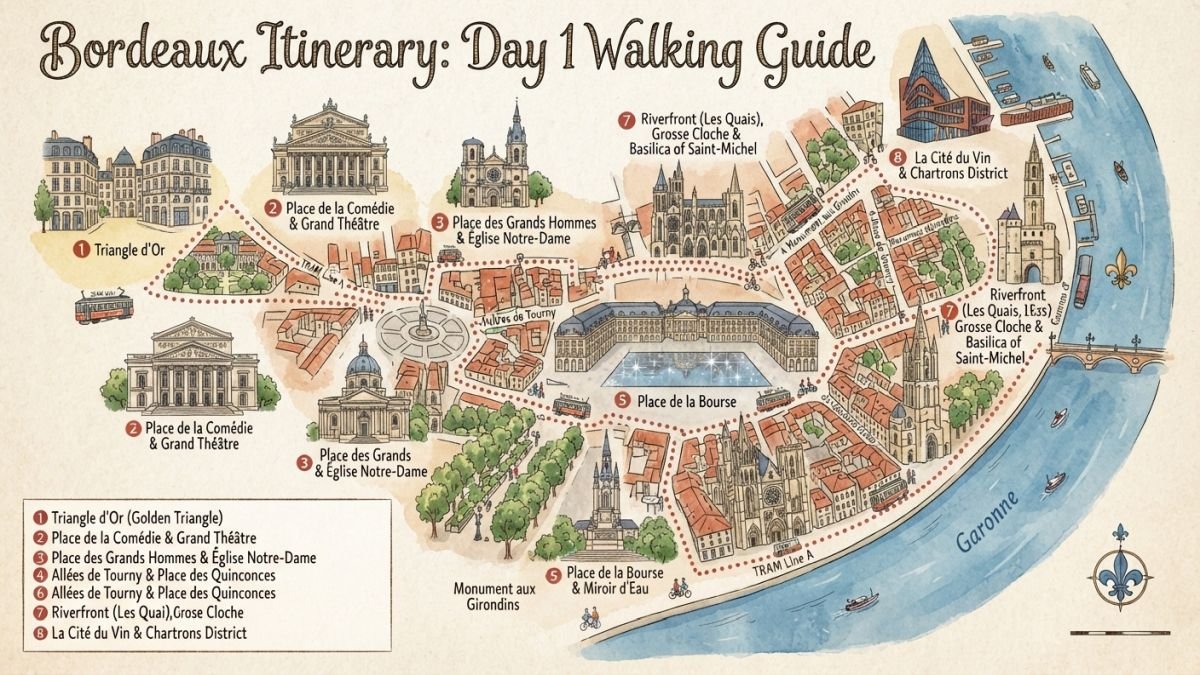
Bordeaux 2-Day Itinerary: Day 1 (Historic Center, Monumental Architecture & Wine Culture)
The first day of this Bordeaux walking itinerary is designed to be explored almost entirely on foot, starting in the neoclassical heart of the city, heading down to the banks of the Garonne River, and ending in the revitalized port district.
Triangle d’Or (Golden Triangle)
Start your morning in the elegant Triangle d’Or, Bordeaux’s most sophisticated neighborhood, framed by three grand avenues: Allées de Tourny, Cours Clemenceau, and Cours de l’Intendance. This area was extensively remodeled in the 18th century during Bordeaux’s “Golden Age,” when maritime trade enriched the local bourgeoisie. The buildings feature uniform pale limestone facades (the famous pierre blonde of Bordeaux), wrought-iron balconies, and mascarons (carved stone faces above windows and doorways, each with a unique expression).
Tip: Walk through the Galerie Bordelaise, a covered shopping passage inaugurated in 1834 with glass-and-iron ceilings, connecting Rue Sainte-Catherine to Rue de la Maison Daurade.
Place de la Comédie & Grand Théâtre
At the eastern tip of the Golden Triangle opens Place de la Comédie, built on the site of an ancient Gallo-Roman temple dedicated to the goddess Tutela. The undisputed centerpiece of the square is the Grand Théâtre, inaugurated in 1780 and designed by architect Victor Louis (at the request of the Marshal of Richelieu).
It is considered one of the best-preserved 18th-century performance halls in Europe. Outside, the portico boasts 12 Corinthian columns crowned by 12 stone statues representing the nine muses of the arts and three goddesses (Juno, Venus, and Minerva). Inside, the monumental stone staircase directly inspired Charles Garnier when designing the Palais Garnier in Paris.
How to visit: If you aren’t attending a performance by the Bordeaux National Opera or ballet, check with the Tourist Office for guided tour dates (schedules vary depending on rehearsals, typically around €8–€10).
Place des Grands Hommes & Église Notre-Dame
A few minutes’ walk away lies Place des Grands Hommes, a circular square named after the great thinkers of the French Enlightenment—every street radiating from it bears the name of a philosopher, such as Montaigne, Montesquieu, Voltaire, Rousseau, or Diderot.
The historic market: A food market has operated here since the early 19th century (originally housed in the former Récollets convent). Following an 1860 wrought-iron structure, the space was transformed in 1991 into a modern three-story glass-and-steel shopping gallery, inaugurated by Queen Elizabeth II, while keeping gourmet stalls, cheeses, and wines on the ground floor.


Right next door, in the tucked-away Place du Chapelet (behind the InterContinental Bordeaux – Le Grand Hôtel), discover the Église Notre-Dame-de-Bordeaux. Built between 1684 and 1707 by the Dominicans, it stands out for its exuberant Baroque facade inspired by the Church of the Gesù in Rome and its bright interior featuring wrought-iron details and a historic organ. Thanks to its remarkable acoustics, it regularly hosts classical music concerts.

Allées de Tourny & Place des Quinconces
Stroll down Allées de Tourny, a wide tree-lined promenade laid out in 1747 by the intendant Marquis de Tourny, lined with historic cafés, traditional shops, and outdoor terraces. At the northern end of the Allées opens the vast Place des Quinconces. Covering roughly 12 hectares along the Garonne River, it is the largest square in France and one of the largest in Europe. It was built in the early 19th century over the ruins of the former Château Trompette (a royal fortress demolished after the French Revolution so it could never again be used against citizens).
What to see in the square: To the west rises the imposing Monument aux Girondins (unveiled in 1902), a 43-meter column topped by the statue of Liberty breaking her chains, surrounded by monumental fountains with bronze seahorses symbolizing the triumph of the Republic. Along the riverfront (to the east), two 21-meter rostral columns symbolize commerce and navigation.

Place de la Bourse & Miroir d’Eau
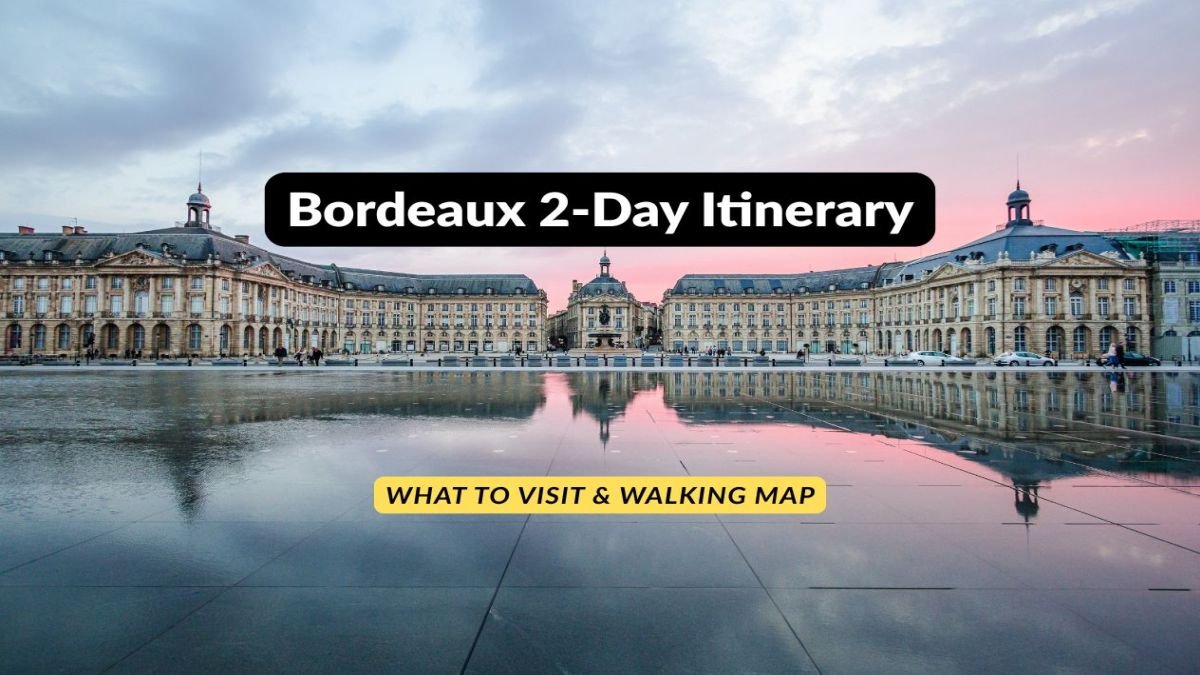
Walking south along the riverfront brings you to the city’s most iconic architectural ensemble: Place de la Bourse. Designed by Ange-Jacques Gabriel (architect to King Louis XV) and built between 1730 and 1755, it marked Bordeaux’s definitive opening to the world, tearing down the old medieval walls to create a square open to the port.
It is symmetrically flanked by the Palais de la Bourse (former stock exchange) and the Hôtel des Fermes (former customs house), with facades richly decorated with bas-reliefs celebrating maritime trade. In the center stands the Fontaine des Trois Grâces (Fountain of the Three Graces), inaugurated in 1869.
Right across the tram tracks lies the Miroir d’Eau (Water Mirror). Opened in 2006 and designed by landscape architect Michel Corajoud, it is the world’s largest reflecting pool (3,450 m²), paved with granite slabs where a thin film of water creates a mirror-like reflection of the 18th-century facades.
The water cycle: The system runs on an automatic continuous cycle of about 15 to 20 minutes: 3 minutes of mist (with refreshing clouds of vapor rising from the ground), 3 to 5 minutes of mirror effect (ideal for photos), and 10 minutes of shallow water.


Medieval Quarter of Saint-Pierre & Saint-André Cathedral
Step into the narrow, cobbled streets of the Saint-Pierre district, the true historic birthplace of Bordeaux (where the ancient Gallo-Roman inner port of Burdigala once stood). The heart of the neighborhood is the lively Place Saint-Pierre, dominated by the 14th- and 15th-century Gothic church of the same name and packed with bistros, wine bars, and terraces.
If you have 20 extra minutes, take a short detour west to Saint-André Cathedral (at Place Pey-Berland), also a UNESCO World Heritage site. It was here in 1137 that Eleanor of Aquitaine married the future King Louis VII of France. Beside the cathedral stands the Tour Pey-Berland, a standalone 66-meter Gothic bell tower you can climb for panoramic views over the historic rooftops.
Riverfront (Les Quais), Grosse Cloche & Basilica of Saint-Michel
Before heading down to Saint-Michel, pass by the Grosse Cloche (Rue Saint-James), one of the few surviving remnants of Bordeaux’s medieval walls and one of the oldest belfries in France (13th–15th centuries). Its two circular towers linked by a central arch house a 7,750 kg bell that once rang to announce the start of the grape harvest or warn of fires. Continue to the Basilica of Saint-Michel, a Flamboyant Gothic church built between the 14th and 16th centuries in the heart of a multicultural, bohemian neighborhood (famous for its antique market and flea markets).
La Flèche Saint-Michel: Detached from the main church building (to prevent the weight and vibrations of the bells from damaging the nave), this spire reaches 114 meters high, making it the second-tallest bell tower in France. Having survived lightning, storms, and harsh weather over the centuries, it has undergone major restoration works—check with the Tourist Office beforehand regarding interior climbing access and opening hours. Return to the Riverfront (Les Quais) for a walk beside the Garonne.

Along its 4.5 km of revitalized promenade, you’ll find themed gardens, bike paths, playgrounds, and the historic Pont de Pierre (Bordeaux’s first bridge, commissioned by Napoleon Bonaparte, featuring 17 arches).

La Cité du Vin & Chartrons District To wrap up the day, hop on the tram (TRAM Line B, La Cité du Vin stop) toward the northern docks area (Bassins à Flot).
The experience: Opened in 2016, La Cité du Vin features bold glass-and-aluminum architecture evoking both wine swirling in a glass and gnarled grapevines. Inside, the permanent exhibition offers an immersive, multisensory journey (with aromas, 3D projections, and an interactive audio guide in multiple languages) through the history and culture of wine around the world.
The highlight: Your ticket includes access to the Belvedere (8th floor, 35 meters up), where you can taste a glass of wine (choosing from Bordeaux labels or international wine regions) while taking in 360° panoramic views over the river and the vertical-lift Pont Jacques Chaban-Delmas.
Hours & tip: Open daily from 10:00 AM (9:30 AM from April to August), closing between 6:00 PM and 7:30 PM depending on the season (closed December 25). On your way back to the center, stop in the neighboring Chartrons district—the former 18th-century wine merchants’ quarter, now filled with antique shops, art galleries, and wine bars along Rue Notre-Dame.

Day 2: Historic Vineyards, Fortresses & the Atlantic Coast
The second day of this Bordeaux 2-day itinerary is dedicated to the extraordinary landscapes surrounding the city. Choose the route that best fits your pace and interests.
Option A (The Classic Choice): Medieval Village of Saint-Émilion & the Médoc Wine Region
Located roughly 40 km east of Bordeaux, Saint-Émilion is a medieval village built like an amphitheater on limestone hills, surrounded by some of the world’s most prestigious vineyards (listed as a UNESCO World Heritage Site for its cultural landscape).

What to see in the village:
Monolithic Church: An underground masterpiece carved directly into the limestone rock between the 9th and 12th centuries—the largest monolithic church in Europe. Visits are guided through the Tourist Office and include access to the catacombs and the hermitage cave of the monk Émilion.
Tour du Roy: A 13th-century Romanesque keep offering panoramic views over the village’s terracotta rooftops and surrounding vineyards.
Cloître des Cordeliers: A former 14th-century Franciscan convent with ivy-draped Gothic arches, where Crémant de Bordeaux sparkling wine is produced and tasted in underground cellars.
Châteaux Wine Tastings: You can walk to historic wine estates right from the village, such as Château Soutard or Château Canon-la-Gaffelière, or sample Saint-Émilion’s famous traditional macarons.
How to get there: Regional TER train from Bordeaux Saint-Jean station (about 35 minutes; the station is roughly a 15-minute walk from the village center).
Experience tip: To visit several estates without worrying about driving, book a guided wine tour of Saint-Émilion or choose a combined itinerary covering both Saint-Émilion and the Médoc château route (1855 Official Classification) with lunch and tastings included.
Option B (Nature & Beaches): Dune du Pilat & Arcachon Bay
About 65 km southwest of Bordeaux, the scenery shifts dramatically from vineyards to the Atlantic Ocean and the pine forests of Les Landes.
Dune du Pilat (Pyla): Standing around 100 to 110 meters high, it is the tallest sand dune in Europe. Reaching the summit (aided by a staircase installed between spring and autumn) rewards you with sweeping views of Banc d’Arguin, Cap Ferret, the Atlantic Ocean on one side, and the vast pine forest on the other.
Arcachon & Oysters: Pair your climb up the dune with a stroll through the seaside resort town of Arcachon (famous for its 19th-century villas) or the bay’s oyster-farming ports, where you can enjoy fresh oysters right by the water.
How to get there: Regional TER train from Bordeaux to Arcachon (about 50 minutes), followed by a local bus to the base of the dune. If you prefer a guided trip with tastings included, book a morning excursion to Dune du Pilat with an oyster tasting.

Option C (History & Fortresses): Citadelle de Blaye & Château de Vayres
If you’ve already explored the vineyards and prefer less crowded historic monuments:
Citadelle de Blaye: Overlooking the Gironde estuary (about 1 hour north of Bordeaux), this 17th-century military citadel was designed by Vauban to protect Bordeaux from naval attacks and is part of the UNESCO-listed Vauban Fortifications network. Entry to the grounds is free, letting you walk along the ramparts and ruins, or join a guided tour to restricted areas like the walled Clos de l’Échauguette vineyard. If you visit on Wednesday or Saturday, enjoy the village’s weekly market.
Medieval Castle of Vayres (Château de Vayres): Roughly 30 minutes by train from Bordeaux (Gare de Vayres station), this historic castle sits beside the Dordogne River. Originally a medieval defensive fortress before gaining Renaissance features, it remains privately owned and inhabited by the same family. It opens seasonally (Easter to November 1) for tours of its tapestry-hung salons, period furniture, and riverside gardens.

It’s the Dune du Pilat, also known as Pyla—Europe’s tallest sand dune, rising over 100 meters above the Atlantic. A staircase helps visitors climb to the top for breathtaking views over Arcachon Bay, and in summer, thrill-seekers can even go paragliding from the summit. Enjoy a morning at Dune du Pilat paired with a fresh oyster tasting!
Aproveita a manhã na Dune du Pilat com degustação de ostras!
Getting Around Bordeaux: Complete Public Transport Guide
Bordeaux’s historic center boasts one of the largest pedestrian zones in Europe, meaning the best way to explore its main monuments, squares, and shopping streets is on foot. However, to reach outlying spots—such as La Cité du Vin, Gare Saint-Jean train station, the right bank of the river, or the airport—the city offers a modern, integrated, and easy-to-use public transit network operated by TBM (Transports Bordeaux Métropole).
1. Tramway (TRAM) — The Backbone of the City Bordeaux has no underground metro (due to the marshy subsoil along the Garonne River), making up for it with an excellent network of modern, quiet surface trams that run without overhead wires in the historic center (powered via ground-level supply to preserve the beauty of historic facades). The network features 4 main lines (operating roughly from 5:00 AM to midnight, and until 1:00 AM Thursday through Saturday):
Line A (Purple): Connects Bordeaux-Mérignac Airport directly to the historic center (Hôtel de Ville / Saint-André Cathedral and Sainte-Catherine), crosses the river via Pont de Pierre to the right bank (Stalingrad), and continues to Lormont/Floirac.
Line B (Red): The most useful line for sightseeing. It crosses the center (Gambetta, Grand Théâtre, Quinconces), passes through Chartrons, and drops you right outside La Cité du Vin.
Line C (Pink): Links the main train station (Gare Saint-Jean) to the heart of the city (Place de la Bourse and Place des Quinconces) and continues north to Bordeaux Lac.
Line D (Green): Connects Quinconces and Tourny to the northwestern suburbs (Eysines / Le Bouscat), passing near Place des Grands Hommes.
2. Buses & River Shuttles (Le Bato)
TBM Buses: Complement the tram network with dozens of daytime routes and night buses (TBNight), reaching neighborhoods not served by tram lines.
River Ferry (Le Bato): A scenic and fun way to cross the Garonne River. This river shuttle (formerly called Bat3) links both banks with main stops at Stalingrad, Quinconces, Les Hangars, and La Cité du Vin / Lormont Bas. Best of all, it uses the exact same ticket as the tram and bus.
3. How to Get from Bordeaux Airport (BOD) to the City Center Upon landing at Bordeaux-Mérignac Airport, you have three main ways to reach downtown:
By TRAM (Cheapest & most convenient): Hop on Line A right outside the terminal. In roughly 35 to 40 minutes, you’ll reach the historic center (Place Pey-Berland / Sainte-Catherine) for the price of a standard TBM ticket (~€1.90).
Express Shuttle Bus (30’Direct): Connects the airport directly to Gare Saint-Jean train station in about 30 minutes (non-stop), with tickets costing around €8.
Private Transfer or Taxi: Ideal if you’re traveling in a group or with heavy luggage, taking you straight to your hotel door in 25 to 30 minutes (you can book a private transfer from Bordeaux Airport with a fixed price in advance).
4. Tickets, Passes & Where to Buy TBM’s ticketing system is fully integrated (one ticket covers tram, bus, and river ferry) and allows unlimited transfers within 1 hour of your first validation:
Where to buy: At ticket machines located at every tram stop (accepting cards and coins), at TBM sales offices, or directly on the official TBM app. You can also pay contactless with your bank card or smartphone straight at the validators onboard (charged at the single-journey fare).
Important note: Always remember to validate your ticket or pass at the yellow/red machines upon boarding the tram, bus, or ferry—even if you hold a Bordeaux City Pass or 24-hour pass, as ticket inspections are frequent and fines are steep.
Is It Worth Renting a Car in Bordeaux?
If you are only visiting the city of Bordeaux, no. Downtown traffic is restricted, many streets are strictly pedestrian or reserved for trams, and public parking is scarce and expensive. Renting a car only makes sense if you want complete freedom to explore scattered wine estates in Médoc, Sauternes, or smaller villages across Nouvelle-Aquitaine—otherwise, combining the TRAM with regional TER trains (to Saint-Émilion or Arcachon) is cheaper and far more convenient.
Best Time to Visit Bordeaux
Spring (April to June) & Autumn (September to October): The best seasons to visit Bordeaux, offering mild temperatures, smaller crowds, and more balanced hotel rates. Note: September is grape harvest season, so some wine châteaux may close to visitors, though in-town wine tastings continue as usual.
Summer (July & August): Ideal if you want to pair the city with Arcachon Bay and Dune du Pilat, though temperatures can get quite hot.
Winter & Christmas: In December, Allées de Tourny comes alive with festive Christmas markets and holiday lights.
Where to Stay in Bordeaux
All Suites Appart hotel Bordeaux Lac – Residence connected to the conference center, just a short distance from La Cité du Vin.
ibis budget Bordeaux Centre Mériadeck – Hotel with an on-site restaurant, 0.8 km from Saint-André Cathedral.
All Suites Appart Hotel Bordeaux Marne – City-center residence with Rue Sainte-Catherine right around the corner.
ibis budget Bordeaux Centre Bastide – Pet-friendly hotel next to a shopping center, just steps from Pont de Pierre.
Première Classe Bordeaux Nord – Lac – Hotel with an on-site restaurant, 2.8 km from La Cité du Vin.
What to Eat in Bordeaux: Local Gastronomy & Wines
Visiting the world capital of wine without exploring its culinary scene is only half the experience. Bordeaux’s gastronomy reflects the bounty of the Nouvelle-Aquitaine region, bringing together Atlantic seafood (like Arcachon oysters), rich southwestern meats, cèpes mushrooms, and sauces and pastries born straight from local winemaking traditions.
1. Canelé de Bordeaux (The City’s Signature Pastry) You can’t stroll through the historic center without catching the scent of vanilla and caramel wafting from local bakeries. The Canelé is a small fluted cylinder pastry originally created in the 18th century by nuns at the Annonciades convent (who used leftover egg yolks from clarifying wine with egg whites).
How it should taste: It features a dark, crisp, deeply caramelized crust (traditionally baked in copper molds coated with beeswax) and a soft, custardy, honeycomb interior flavored with Bourbon vanilla and rum.
Where to try it: The historic chain Baillardran (with shops across Triangle d’Or and Rue Sainte-Catherine) is the most iconic, though La Toque Cuivrée makes equally delicious canelés at a noticeably lower price—great for picking up a gift box.
2. Entrecôte à la Bordelaise & Bordelaise Sauce The quintessential meat dish in Bordeaux bistros is Entrecôte à la Bordelaise (grilled ribeye steak, traditionally from Bazas or Blonde d’Aquitaine cattle), topped with famous sauce bordelaise.
The secret behind the sauce: Made from a reduction of Bordeaux red wine, minced shallots, beef stock, herbs, and bone marrow (moelle), creating a dark, glossy, deeply savory sauce.
Where to try it: At traditional bistros in the Saint-Pierre quarter or at the classic L’Entrecôte (near Place de la Comédie, famous for its single-dish steak-frites menu with secret sauce—no reservations accepted).
3. Arcachon Bay Oysters & Seafood Proximity to the Atlantic Ocean means fresh oysters from Arcachon-Cap Ferret appear on nearly every Bordeaux menu, served raw on ice with lemon wedges or shallot vinegar, paired with rye bread, salted butter, and a crisp dry white Entre-Deux-Mers wine.
Foodie tip: In Bordeaux, it’s tradition to eat oysters alongside small hot grilled sausages called crépinettes—the contrast between the cold, briny oyster and the warm sausage is a beloved local staple at city food markets.
4. Other Regional Specialties Not to Miss
Magret & Confit de Canard: Duck breast or duck leg slow-cooked in its own fat until the skin turns golden and crisp, usually served with garlic-and-duck-fat potatoes (pommes de terre sarladaises) and cèpes mushrooms.
Lamproie à la Bordelaise: For adventurous eaters, lamprey slow-braised in a rich Bordeaux red wine sauce with leeks and cured ham is a prized seasonal delicacy.
Dunes Blanches: A modern creation from Cap Ferret that took Bordeaux by storm—light sugar-dusted choux puffs filled with airy vanilla whipped cream.
5. Bordeaux Wines: What to Order at a Wine Bar Bordeaux primarily produces blended wines (assemblage), combining red grapes like Cabernet Sauvignon, Merlot, and Cabernet Franc, or white grapes like Sauvignon Blanc and Sémillon. If you’re unsure what to order, follow the two riverbanks:
Left Bank (Médoc, Graves, Pessac-Léognan): Cabernet Sauvignon-dominant—more structured, tannic, age-worthy reds.
Right Bank (Saint-Émilion, Pomerol): Merlot-dominant—softer, fruitier, rounder reds.
Sauternes & Entre-Deux-Mers: For whites, try a crisp dry Entre-Deux-Mers with seafood, or a sweet noble-rot Sauternes alongside Roquefort cheese or foie gras.
6. Best Food Markets & Dining Areas in Bordeaux
Marché des Capucins: Known as the “Belly of Bordeaux,” this is the city’s largest covered market and the best spot for a casual lunch at oyster bars, cheese counters, charcuterie stalls, and French tapas stands.
Halles de Bacalan: Right across from La Cité du Vin, this modern gourmet food hall brings together over twenty local producer stalls—ideal for grabbing a bite before or after visiting the museum.
Saint-Pierre & Chartrons: Saint-Pierre packs dozens of historic restaurants and bistros into the center, while Rue Notre-Dame (in Chartrons) offers a more bohemian, local dining vibe.
Frequently Asked Questions About Bordeaux (FAQ)
How many days do you need to visit Bordeaux?
2 full days are enough for a great first visit: one day for the historic center (Place de la Bourse, Miroir d’Eau, Grand Théâtre) and La Cité du Vin, and a second day for a day trip to Saint-Émilion or Dune du Pilat.
How do you get from Paris to Bordeaux?
The high-speed TGV train connects Paris Montparnasse station to Bordeaux Saint-Jean in just over 2 hours.
How do you get from Paris to Bordeaux?
Rue Sainte-Catherine, a 1.2 km pedestrian street linking Place de la Comédie to Place de la Victoire.
SHARE THIS ITINERARY
Know someone planning a getaway to Bordeaux?
Send this guide to the friends you’re traveling with or share it on social media to help anyone organizing a trip to France — covering wines, historic architecture, public transport, and great food.
Share this guide